
Syria’s historical sites are among the strongest reasons travelers add the country to their Middle East itinerary. From the old streets of Damascus and Aleppo to castles, ancient cities, and coastal heritage, each place tells a different part of Syria’s story. This guide highlights ten important historical sites to consider when planning a Syria tour, with practical notes on route timing, local support, and changing access conditions.
Access and travel conditions can change, so treat this list as a planning guide rather than a fixed route. If you want help building a realistic itinerary, Octopus Tourism can support you with Syria tours, travel consultation, accommodation, and local planning.
1. The Old City of Damascus
Damascus is the oldest continuously inhabited capital on the planet. Wandering the Old City — a UNESCO World Heritage site — you pass the magnificent Umayyad Mosque, the bustling Al-Hamidiyah Souq, ancient Roman arches, and Straight Street, mentioned by name in the New Testament. Allow at least a full day; better, two. The Old City is best explored slowly with a knowledgeable local guide, available through our leisure tourism packages.
2. The Umayyad Mosque
One of the largest and oldest mosques in the world, completed in 715 CE on a site that has hosted worship for over 3,000 years. Its golden mosaics, vast courtyard, and the shrine said to contain the head of John the Baptist make it spiritually and historically extraordinary. Modest dress is required and robes are provided at the entrance.
3. Krak des Chevaliers (Qalaat al-Hosn)
Lawrence of Arabia called Krak des Chevaliers “the finest castle in the world,” and standing inside it you understand why. Built by the Knights Hospitaller in the 12th century, this Crusader fortress with its concentric walls and dramatic hilltop position is remarkably well preserved. Allow 2–3 hours and combine the visit with the nearby village of Marmarita for lunch.
4. Palmyra (Tadmur)
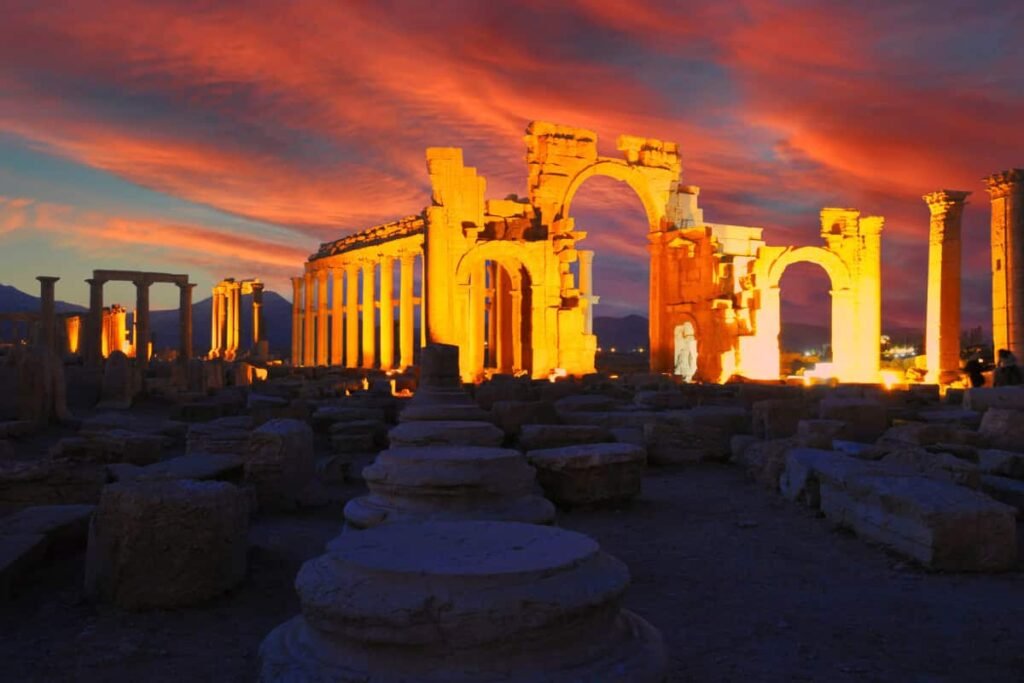
The ancient caravan city of Queen Zenobia rises out of the Syrian desert like a vision: colonnaded streets, the Temple of Bel, the theater, and rows of tower tombs. Although Palmyra suffered damage during recent conflicts, large portions remain breathtaking and ongoing restoration work is impressive. When access and timing allow, sunrise or sunset can be especially memorable.
5. The Old City of Aleppo
A second UNESCO-listed Old City, Aleppo’s medieval citadel rises 50 meters above the surrounding maze of khans, hammams, churches, and madrasas. The reopened sections of the Old Souq, partially restored after years of work, give a powerful sense of the city’s centuries as a Silk Road trading hub. Aleppine cuisine — kibbeh, cherry kebab, sweet halawet el-jibn — is reason enough to visit.
6. Bosra and its Roman Theater
Two hours south of Damascus lies Bosra, a black basalt city built by the Romans in the 2nd century. Its 15,000-seat theater is one of the best-preserved in the Mediterranean, with original stage walls still standing. Walking the cardo maximus past Roman baths, churches, and a still-working ancient cistern feels like time travel.
7. Maaloula
This cliffside Christian village an hour from Damascus is one of the very few places on earth where Western Aramaic — the language Jesus spoke — is still part of daily life. Visit the Monastery of St. Sergius (Mar Sarkis), one of the world’s oldest, and the Monastery of St. Thecla cut into the rock. The setting alone, white and pastel houses clinging to red cliffs, justifies the trip.
8. The Norias of Hama
The giant wooden waterwheels of Hama have turned on the Orontes River for over 700 years. The largest, Al-Mohammadiyya, is more than 20 meters in diameter and produces a deep, almost musical groan as it lifts water into the city’s old aqueducts. Hama is also a relaxed, charming city in its own right and a great base for visiting Apamea.
9. Apamea
A 2-kilometer Roman colonnaded street — once the second longest in the empire — still stands in the open countryside near Hama. Walking it almost alone at golden hour, with sheep grazing nearby and no tour buses in sight, is one of those rare archaeological experiences you simply cannot have in Italy or Turkey anymore.
10. The Dead Cities
Between Aleppo and Idlib lie hundreds of abandoned Byzantine villages — full churches, houses, and oil presses still standing in stone after 1,500 years. Serjilla and Al-Bara are often included when route conditions allow. UNESCO inscribed them as the “Ancient Villages of Northern Syria.” For lovers of empty, atmospheric ruins, nothing in the Mediterranean compares.
How to Visit These Sites Practically
- Best season: March–May and September–November offer ideal temperatures.
- Recommended duration: 8–12 days to comfortably cover most of the list.
- Transport: Private car with driver-guide is far easier than public transport.
- Accommodation: Boutique heritage hotels in Damascus and Aleppo are unforgettable. See our hotels and furnished apartments page.
- Entry & visa: Requirements can vary by nationality and timing, so always confirm the latest entry process before travel. Octopus Tourism can help you understand the current steps and prepare the required arrangements.

